

Three seconds. That is how long a machine learning model needs to scan biometric data from 22 players on a football pitch, cross-reference it with ten seasons of historical statistics, and produce an outcome estimate. Where a seasoned analyst spends a week compiling figures, the machine has already delivered its verdict, and that verdict now carries real weight among sports betting platforms and professional franchises alike. Sports forecasting looks nothing like it did five years ago. The old statistical methods, the ones that relied on goal averages and league standings, feel almost handcrafted compared to the neural networks running today.
The global sports analytics market, valued at roughly 5.8 billion dollars in 2025, is expected to surpass 7 billion in 2026 according to Fortune Business Insights. Annual growth above 20 percent tells you something very specific about the appetite that sports organizations have for data. But the question worth sitting with goes beyond raw numbers. Can you genuinely trust an algorithm to anticipate what happens on a pitch, a track, or a court?
How Algorithms Read The Game Differently
A neural network trained on sports data does not work like an expert watching a match on television. Where the human eye remembers a spectacular play or a missed shot, the algorithm ingests everything. The exact distance of every pass, completed or not. Acceleration variations during each sprint. The tactical context surrounding every foul committed.
What Recent Models Now Process
The latest models go far beyond classic statistics. Among the variables that cutting-edge prediction systems now factor in, you will find elements that would have seemed absurd three years ago.
- A player’s muscular fatigue index during their third match in eight days
- An individual referee’s historical tendency to award penalties in the final ten minutes
- Atmospheric pressure and humidity levels on match day
- The number of completed passes under pressure over the last five games
- Aerial duel win rates depending on wind conditions
In Formula 1, teams analyze millions of telemetry data points per second to fine-tune pit stop strategies. That density of data, unthinkable for a human brain, represents the daily raw material of predictive algorithms.
Technical Foundations Behind The Predictions
Models like XGBoost, Random Forest, and attention-based architectures borrowed from natural language processing form the technical backbone of this quiet revolution. Attention mechanisms, for instance, process a sequence of sporting events exactly as they would process a sentence. A typical at-bat sequence in baseball, including pitch type, location, current count, and outcome, forms a “sentence” that the model learns to anticipate after millions of similar examples. Validated research has shown these contextual embeddings outperform traditional advanced metrics for individual performance forecasting.
In 2024, a standard football match prediction model worked with about a dozen variables. By 2026, the best systems ingest over 200. This is not complexity for its own sake, because each additional variable improves model calibration by small fractions of a point, and that is what separates a profitable prediction from a marginal one.
The speed at which these tools evolve is striking. Two years ago, most prediction platforms operated on static pre-game data and updated nothing once the whistle blew. Today, the strongest systems run continuous recalculation during live events, adjusting probabilities after every significant play. A red card in the 30th minute, a substitution at halftime, a sudden rainstorm at the hour mark, each of these triggers a cascade of recalculated outcomes within milliseconds. For spectators accustomed to checking halftime odds, this granularity is new territory.
Precision Rates And Numbers That Matter
The accuracy promises around sports AI deserve a cold, hard look. A human analyst, even an experienced one, rarely exceeds 60 percent correct predictions on match outcomes. Cognitive biases, overrating big-market teams, emotional attachment to a star player, all of it drags down clear judgment. Machine learning models post rates oscillating between 70 and 85 percent, depending on the discipline and available data.
Accuracy Breakdown by Discipline
This is not uniform across sports. Basketball, with its frequent scoring events and abundant individual statistics, lends itself to prediction far better than football, where a single goal can flip the entire script. Tennis presents an interesting case through its individual duel nature, but a player’s physical and mental form on match day remains stubbornly hard to quantify.
| Discipline | Estimated AI Accuracy | Average Human Accuracy | Key Factors |
| Basketball | 78-85% | 55-62% | High scoring volume, rich individual data |
| Football | 70-78% | 52-58% | Low goal count, collective tactics |
| Tennis | 72-80% | 54-60% | Individual duel, variable physical form |
| Baseball | 75-82% | 53-59% | Detailed pitch data, deep historical records |
| Ice Hockey | 68-75% | 50-55% | Recent tracking adoption, fast-paced sport |
These figures come from compilations by WSC Sports and AI News Hub based on 2025 studies. The wide range reflects methodological variability, with some models tested on narrow samples.
Ice hockey shows the gap between late adoption and rapid catch-up. Puck tracking was historically limited by size and speed constraints. With RFID sensors now deployed in pucks and jerseys across all NHL arenas, combined with computer vision, real-time spatial data flows from every rink. Talent scouting for young prospects has become these algorithms’ favorite playground.
Injury Prediction And Recovery Monitoring
Physical-risk monitoring has also become more advanced. Models trained on biomechanical and training-load data can estimate fatigue and injury-risk patterns with increasing precision. When a basketball player’s fatigue index and landing patterns resemble higher-risk movement profiles, the system can trigger an internal workload alert. Several elite teams now consult analytics dashboards displaying injury risk scores, and those scores directly influence rest and rotation decisions.
Cricket provides another revealing example. Professional leagues across South Asia produce massive data volumes per match, with detailed individual statistics for every batter and bowler. Algorithms find fertile ground there, especially in short formats like T20 where game patterns are more repetitive and therefore more predictable. The Indian Premier League alone generates enough data per season to train a dedicated neural network from scratch, and several analytics firms have done exactly that, building models tuned specifically to the rhythms and oddities of franchise cricket.
A Multi-Billion Dollar Market in Full Acceleration
The growth of the sports analytics market tells an economic story that goes beyond simple tech enthusiasm. According to Precedence Research, global value should climb from 6.6 billion dollars in 2026 to nearly 30 billion by 2034, carried by a compound annual growth rate above 20 percent.
Geographic Distribution of Market Value
- North America represented 41 percent of the market in 2025 at 2.38 billion dollars, driven by wearable device adoption and GPS tracking systems
- The Asia-Pacific region posts the fastest growth, fueled by investments in connected sports infrastructure and the rise of e-sports
- Africa and the Middle East, at 0.54 billion in 2025, show particular momentum through sports technology incubators
- South America accounted for 0.38 billion in 2025, representing 6.6 percent of global demand, with growing adoption by professional teams and leagues
Football leads the charge among disciplines, with a projected growth rate above 20 percent between 2026 and 2033. Cricket follows closely, largely thanks to league popularity across South Asia.
Online Betting Sector Expansion
For those interested in wagering platforms, creating an account through specialized sites such as www.1xbet.tz/user/registration remains a common step in many regions where the digital offering is expanding fast. The AI-powered sports wagering sector is experiencing its own expansion, growing from 10.8 billion dollars in 2025 toward an estimated 60 billion by 2034, according to WSC Sports projections. Betting operators invest heavily in predictive models to adjust odds in real time, offer wagers on micro-events, and personalize recommendations.
What Sensors See And You Do Not
Underneath the jerseys of professional athletes sit devices recording far more than distance covered. GPS trackers, heart rate monitors, accelerometers, and smart clothing manufactured by STATSports, Catapult, and KINEXON capture continuous data streams. Distance, sprint intensity, impacts, recovery between efforts, all of it measured and transmitted to analysts on the sideline. The sheer volume is staggering. A single Premier League match generates enough tracking data to fill thousands of spreadsheet rows, and that is just the spatial information, before adding biometric readings.
In March 2025, STATSports launched AI-equipped wearable technology capable of providing coaches with instant insights into player body mechanics and performance. This type of tool does more than measure. It interprets. The distinction matters, because a raw speed or heart rate figure means nothing without context. It is the correlation between hundreds of variables that produces an actionable signal. Coaches who once relied on gut feeling about when to substitute a tiring midfielder now receive quantified fatigue alerts, and those alerts have proven accurate enough that some clubs have restructured their entire rotation strategy around them.
Algorithmic Judging And Officiating
The International Gymnastics Federation crossed a symbolic threshold by approving Fujitsu’s AI system as an official judge, used during world championships to settle scoring disputes. When an algorithm delivers a scoring verdict on a gymnastic routine, the implications for objectivity in sports judging are significant. VAR in football analyzes actions in real time to detect fouls and offsides with increasing precision. The debate over technology’s role in officiating decisions is far from settled, but data shows that error rates decline season after season in competitions using these systems.
Streaming And The Viewer Experience
Broadcasters are not standing on the sidelines either. Streaming platforms integrate AI to personalize the viewing experience, with real-time statistical overlays, automatically generated replays, and content recommendations tailored to each profile. Over 118 million viewers watched sports via streaming in 2025 according to eMarketer projections, a 70 percent increase from 2021. That online audience demands predictive analysis that adds more context to the viewing experience.
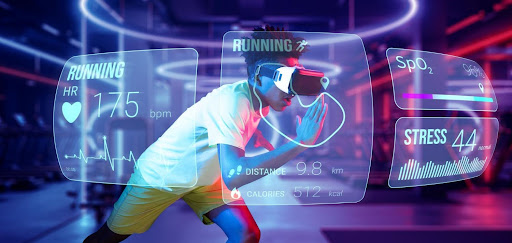
Augmented reality is gradually moving in too. Headsets like the Meta Quest Pro and Apple Vision Pro allow athletes to replay match phases, simulate tactical situations replicating opponent behavior. Applications like TonCoach and CoachMe App are working to bring this technology to amateur sports, though their features remain under development for some uses in 2026. Specialized sports analysis chatbots represent yet another step forward. Platforms like IBM Watson analyze entire matches and generate personalized summaries for viewers. You can ask a virtual assistant to compare two players’ statistics over the last three months, and the answer arrives within seconds, complete with supporting charts. That kind of access used to cost professional scouting departments serious money, and now it sits in a browser tab.
Blind Spots in Algorithmic Prediction
An algorithm that reaches 80 percent accuracy gets it wrong one time out of five. And that error is not random. It tends to surface in situations that historical data describes poorly. A player switching clubs and adapting slowly to a new tactical system. A team affected by a non-sporting event that damages locker room morale. A goalkeeper delivering the performance of a lifetime for no statistically apparent reason. These human factors, stubbornly difficult to quantify, mark the frontier that algorithms struggle to cross.
The Black Box Problem
Most advanced deep learning models operate opaquely, even for their creators. When a model predicts a win with 73 percent confidence, nobody can simply explain which variables weighed most in that estimate. This opacity feeds certain distrust, including among sports professionals who use these tools on a daily basis.
The question of biased data also deserves attention. Models trained primarily on North American or European leagues perform worse when applied to African, Asian, or South American championships, where historical data volumes are thinner and playing conditions differ. An algorithm raised on a diet of Premier League and NBA data does not necessarily read the subtleties of West African football or Caribbean cricket. This imbalance reflects a broader representation problem in training datasets, one that developers are only beginning to address by diversifying their sources.
Practical Limits on The Pitch
Weather, often included as a variable, illustrates the boundary well. A model knows that a wet pitch slows down play. But it does not know that the right winger has a fragile ankle that bothers him on soaked grass, or that the opposing coach systematically switches formation when it rains. These fine adjustments still escape the machine.
The more bettors use AI to compare markets, the more operators adjust their models in response. In 2026, both sides of the market employ advanced systems. The difference comes down to scale, because operators command computing power and data volumes that dwarf those available to an individual user, even one equipped with a solid predictive tool. Market differences tend to narrow once the same information becomes widely available. And while models keep sharpening on both sides, a goalkeeper somewhere will save an impossible penalty on a semifinal night, without any algorithm having seen it coming.