
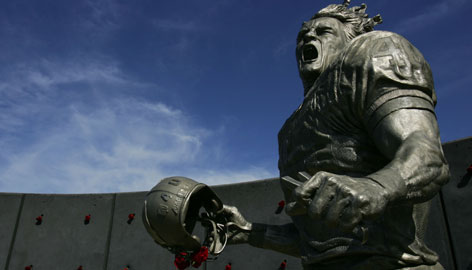
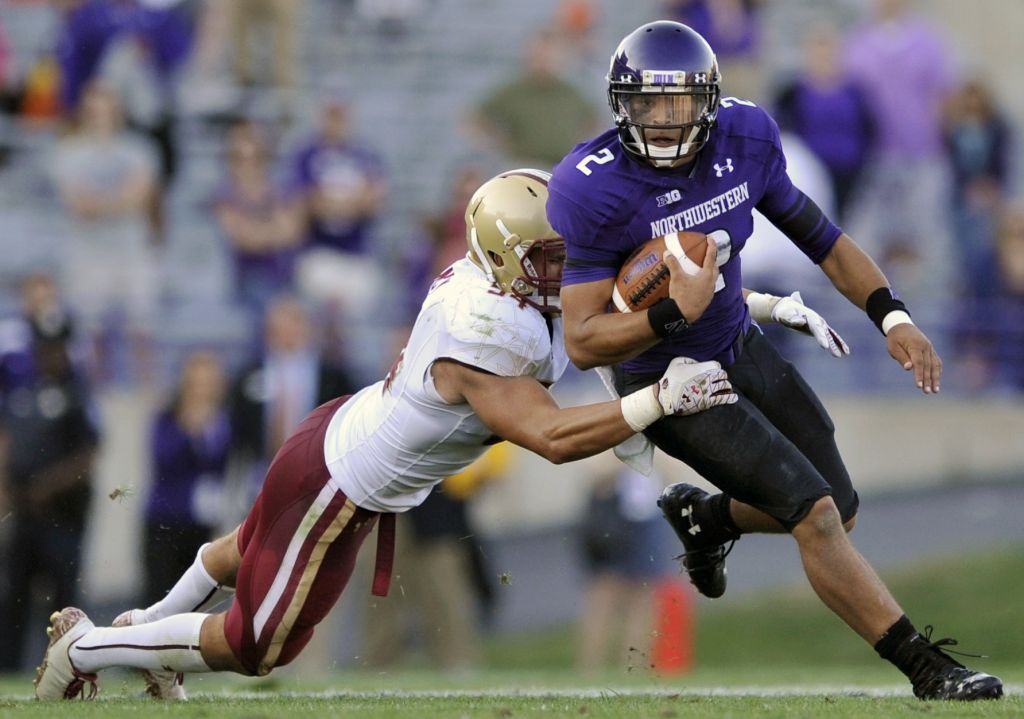
Kain Colter testified today at day one of the NLRB hearing that will rule on the status of CAPA as a valid labor organization. His comparisons of football to the military are getting some backlash. Even though the sport of football is rooted in military traditions. Some pundits are deriding Colter for comparing football training to military training. That’s understandable as football is just win or lose, not life or death. However, here I provide a history lesson on football being literally a “war game” in order to provide proper context of this discussion.
First here’s what Colter said:
He likened preparing for a college football game it to military personnel operation in Iraq. He did not compare Northwestern football to go going off to war. Not in any sense. He just mentioned the word “operations.”
“I like to think of it like the military/Navy SEALs. They spend months preparing for operations. It’s the same thing as football. We spend months getting ready for our operations,” Colter said.
Also, it’s pretty easy to see where Colter might come up with the football to war analogies.
NU did literally train with the Navy Seals in the offseason at Camp Kenosha this past summer. Northwestern has held practices at Great Lakes Naval Base during Colter’s four years in Evanston.
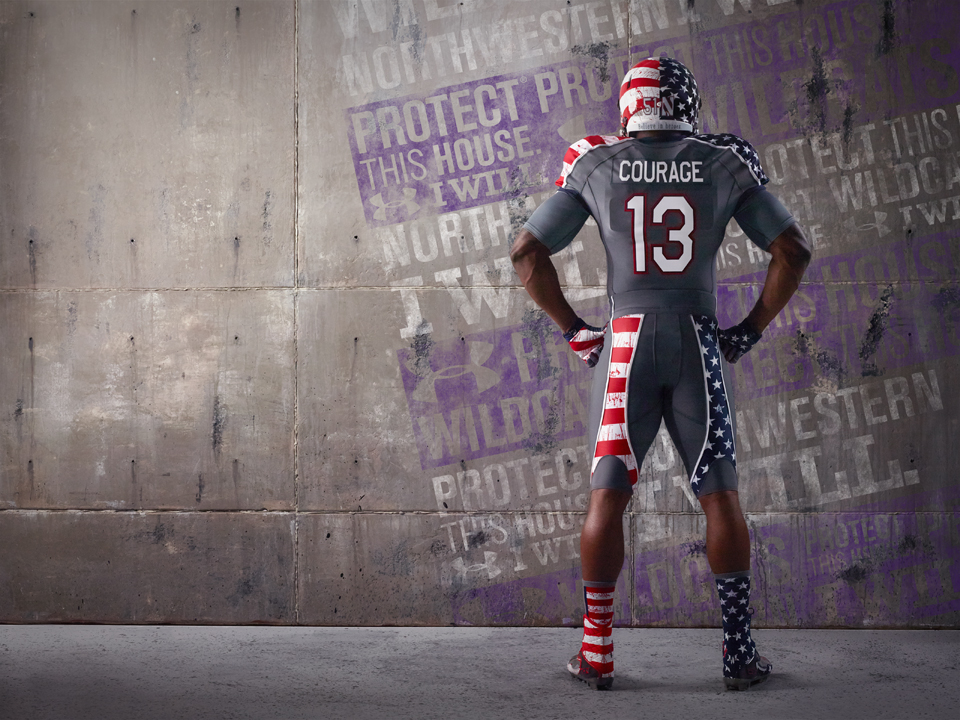
On top of that, you had the jingoistic and offensive uniforms they wore in the home game versus Michigan this past November. Uniforms that literally displayed “core values of the military” on the back of the jerseys in places where a player’s last name would go.
So although it might not seem like an apt comparison to you. One can see where Kain is going with this analogy.
(Update: Kain Colter explains his comments and answers his critics)
However, the war hawkishness and militaristic jingoism of football is anything but new. And it’s certainly not limited to Northwestern.
This sport of warrior-poets has produced many prominent politicians: Steve Largent, J.C. Watts, Jack Kemp, Richard Nixon, Ronald Reagan, Gerald Ford, and Lynn Swann. All played college or professional football and are Republicans (traditionally the more war hawkish party) Socially conservative Heath Shuler was once elected representative of North Carolina’s 11th district.
He is the first football player turned elected Democrat since Senator John Glenn. There is more at work here than just coincidence. The underlying ethos of football, Republicans and the military is a concept called “strict father morality,” explained clearly in George Lakoff’s book “Don’t Think of an Elephant: Know Your Values and Frame the Debate: the Essential Guide for Progressives.”
And you have to include the famous George Carlin bit when talking about this topic:
War Games
“We’re soldiers. Any time somebody invades our home it’s going to be a battle,” University of Illinois starting quarterback Tim Brasic told me at 2005 Illinois Media Day. Two days later at Chicago Bears (who play their home games in SOLDIER Field) training camp I brought up the “trench warfare” football linemen engage in to Bears defensive tackle Darrel Campbell.
“The key word you used there is warfare. Seriously, it’s definitely warfare, and Coach Johnson is helping us a lot with the warfare,” he said.
I have a zillion of these types of quotes. From every presser.
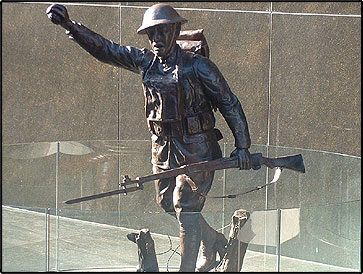
Football is a game, but it is also a metaphor for war; its roots and history show it originated as a stand-in for military service. There are jingoistic and militaristic traditions in football that all other sports lack; the specific offensive and defensive-minded lingo, manipulation of lines and forces with supplemental strategic reinforcements that mirror the planning generals do for battle.
Red Grange was football’s first collegiate and professional superstar. Hear are some choice quotes from John M. Carroll’s tome Red Grange and the rise of Modern Football.
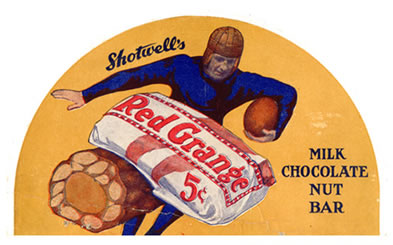
“Between 1915 and 1917, educators engaged in a vigorous debate over how to prepare American youth for war if the United States entered the European conflict. Football was one of many sports that would benefit from the wartime and postwar emphasis on physical education in public schools.” ( p34)
“It was a violent and virile sport for gentlemen who were concerned about their manhood in an increasingly sedentary society and questioned their ability to measure up to the past generation that had been tested in combat.” (page 25)
“Two forces, public realization of how exciting the “new football” produced by the earlier rules changes had become and the stimulus that war gave to the game, were converging to generate one of the greatest growth periods in the history of football.” (page 34)
War Eagle
I’ve played the game in high school and covered it on both the college and professional level, so I’ve experienced the march in formation from the locker room to the stadium, (Going off to war), run out through the tunnel screaming and yelling to take the (battle) field with my teammates (or platoon if you will). There’s nothing quite like the eerie quiet seriousness that surrounds an army company or a football team in the waning moments before battle is to ensue. Football contains a Draconian chain of command that requires unwavering and unquestioning adherence to your commanding officer. College football fight songs (notice they are called FIGHT songs not SPIRIT songs) sound exactly like military marching music.
College football rivals NASCAR as the predominant red-state sport. It’s more popular in the traditionally most hawkish states which are overwhelmingly rural in population. The college football polls are dominated by schools in the red states. The rest are pretty much in Florida; the one truly “purple state.”
In Thomas Frank’s What’s the Matter with Kansas? He describes the cultural stereotype, the somewhat inaccurate, yet still widely held narrative of the region on page 25. “A red-stater is loyal. This is the part of the country that fills the army’s ranks and defends the flag against all comers. Red America is never redder than on our bloodiest battlefields and a grievances. You know, the usual one, the one you saw in Rambo, the one where all the cowards of the coasts stab the men of red land in the back during the Vietnam War.”
Paul M. Banks owns The Sports Bank.net, an affiliate of Fox Sports. An MBA and Fulbright scholar, he’s also a frequent analyst on news talk radio; with regular segments on ESPN,NBC, CBS and Fox. A former NBC Chicago and Washington Times writer, he’s also been featured on the History Channel. President Obama follows him on Twitter (@paulmbanks)