
The team sheet drops an hour before kickoff. Within seconds, fans are debating the manager’s choices. Is that a defensive midfield? Why is a winger playing centrally? And what exactly does a 4-2-3-1 formation tell us about the way a team intends to play?
For Premier League followers, checking predicted and confirmed starting XIs on matchxi.com is a useful starting point for understanding matchday selections. But knowing who starts is only half the story. Understanding how those players fit together can reveal much more about a team’s tactical intentions.
The 4-2-3-1 is one of modern soccer’s most recognizable formations. Its popularity comes from a simple idea: provide enough protection in midfield without sacrificing attacking options.
Yet there is considerably more to it than four numbers on a television graphic.
What Is the 4-2-3-1 Formation in Soccer?
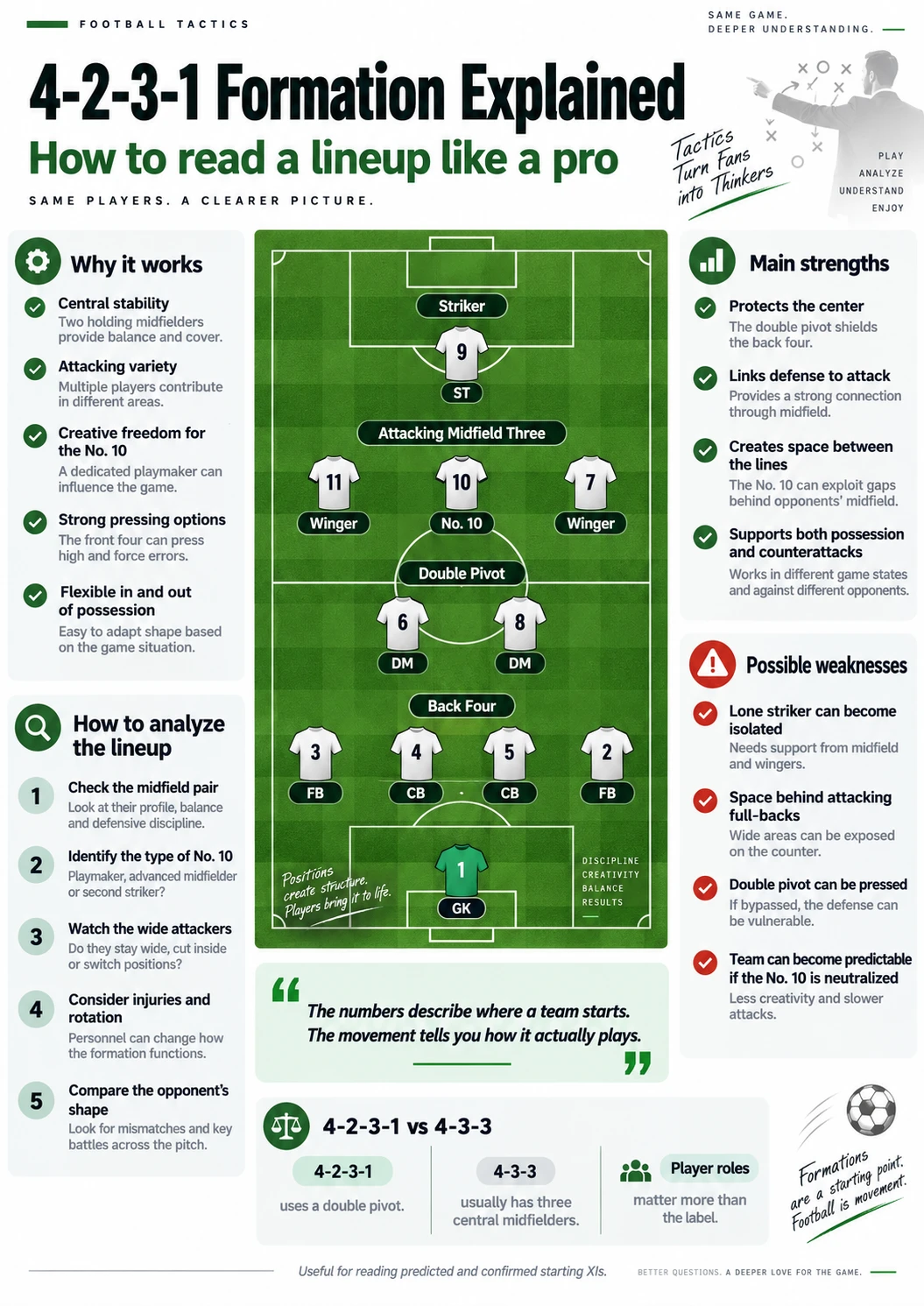
The numbers describe how a team’s ten outfield players are arranged across four horizontal lines, starting from defense.
A traditional 4-2-3-1 formation includes:
- Four defenders: Two center-backs and two full-backs.
- Two defensive or central midfielders: Usually referred to as the double pivot.
- Three attacking midfielders: One central playmaker and two wider attacking players.
- One striker: The center-forward leading the attack.
The goalkeeper isn’t included in the numbers.
Here’s how the formation breaks down:
| Position | Players | Main responsibility |
|---|---|---|
| Back four | 4 | Protect the goal, build attacks and provide width through the full-backs |
| Double pivot | 2 | Control central areas, recover possession and connect defense with attack |
| Attacking midfield three | 3 | Create chances, move between lines and support the striker |
| Center-forward | 1 | Lead the attack, occupy defenders and finish opportunities |
At first glance, this looks relatively straightforward. Four players defend, two control midfield, three support the attack, and one tries to score.
Real soccer, however, is rarely that simple.
The formation depends heavily on the individual players, their movement and the instructions they receive.
Why the Double Pivot Is the Heart of the System
If there’s one tactical feature that separates the 4-2-3-1 from many other formations, it’s the pair of central midfielders positioned directly ahead of the defense.
This pairing is called the double pivot.
Imagine a Premier League team facing an opponent that presses aggressively. Whenever a defender receives the ball, an opposing forward closes down the passing options.
With two midfielders operating in deeper positions, the team has additional passing angles and a better chance of moving possession forward.
The two players don’t necessarily perform identical roles.
One may focus on winning tackles, intercepting passes and protecting the center-backs. The other might be more comfortable carrying the ball or passing through opposition lines.
When the partnership works, the team can move between defensive stability and attacking possession without leaving enormous gaps in midfield.
When it doesn’t, the problems become obvious. The attacking players become disconnected, the defenders face additional pressure, and possession can repeatedly break down before reaching the final third.
The Number 10: The Player Who Connects Everything
One of the most interesting positions in the 4-2-3-1 soccer formation is the central attacking midfielder, commonly known as the number 10.
This player operates behind the striker and ahead of the double pivot.
Their job is not simply to provide assists.
A good number 10 reads defensive spaces, creates passing angles, receives possession between opponents and forces defenders into uncomfortable decisions.
Consider a simple situation.
The striker occupies both center-backs. Meanwhile, the number 10 moves into the space between the opposition’s midfield and defensive lines.
An opposing midfielder now has a decision to make: follow the number 10 and leave space behind, or hold position and allow the attacking midfielder to receive the ball.
Either choice can create an opportunity.
However, not every number 10 plays like a traditional creative playmaker. Some are energetic pressers, others make late runs into the penalty area, and some operate almost like a second striker.
That’s why two Premier League teams can use the same formation but produce completely different attacking styles.
Why Managers Like the 4-2-3-1
The biggest attraction is flexibility.
Managers can adjust the formation to different opponents without necessarily making substitutions.
Several tactical advantages explain its continued use:
- Central stability. The double pivot provides protection against counterattacks and helps retain possession.
- Attacking variety. Wide players can stretch the field, cut inside or combine with overlapping full-backs.
- Creative freedom. The number 10 can operate between defensive lines and connect with the striker.
- Pressing options. The attacking midfielders can press high while deeper players cover spaces behind them.
- Tactical adaptability. The shape can change during possession, defensive transitions and substitutions.
This versatility matters throughout a long domestic season.
Teams frequently encounter opponents with very different tactical approaches. One weekend might require dominating possession against a deep defense. The next could demand disciplined defending against a stronger attacking side.
A well-organized 4-2-3-1 can provide a useful foundation for both situations.
The Formation on Paper Isn’t the Formation on the Field
Here’s something television graphics rarely explain: soccer formations constantly change.
The numbers describe where a team starts. The movement tells you how it actually plays.
A team listed in a 4-2-3-1 might defend in a 4-4-2.
How?
The wide attacking midfielders drop deeper, while the number 10 moves alongside the striker to pressure the opposition’s defenders.
Suddenly, the original formation looks completely different.
The same transformation happens in possession.
One or both full-backs might push forward. A defensive midfielder may drop between the center-backs. The wide forwards can move into central scoring positions.
These movements change the team’s structure without changing the starting lineup.
For supporters, this explains why simply identifying a formation doesn’t tell the whole tactical story.
The starting shape is a reference point, not a fixed set of coordinates.
4-2-3-1 vs. 4-3-3: What’s the Difference?
Both formations are common in modern soccer, and they can look surprisingly similar during matches.
The traditional 4-3-3 features three central midfielders, often with one holding player behind two more advanced midfielders.
By contrast, the 4-2-3-1 generally begins with two deeper midfielders and a more clearly defined attacking midfielder.
That distinction can influence how a team progresses the ball.
A 4-3-3 might rely on its two number 8s moving into advanced positions. The 4-2-3-1 often places greater emphasis on the relationship between the double pivot and the number 10.
Neither system is automatically more attacking.
A conservative 4-3-3 can create fewer chances than an aggressive 4-2-3-1, while a possession-oriented 4-2-3-1 may spend much of a match circulating the ball around midfield.
Player instructions matter far more than the formation label alone.
What Are the Weaknesses of the 4-2-3-1?
No soccer formation works perfectly against every opponent.
Despite its advantages, the 4-2-3-1 has several potential vulnerabilities.
An isolated striker
If the attacking midfielders stay too deep, the lone striker may struggle to receive support. This is especially problematic against opponents defending with two strong center-backs.
Space behind attacking full-backs
Full-backs often provide much of the attacking width. If both advance simultaneously and possession is lost, opponents may find space for fast counterattacks.
Pressure on the double pivot
Aggressive opponents can target the two central midfielders, cutting off passing routes and forcing defenders into long balls.
An ineffective number 10
When the central attacking midfielder cannot receive possession between the lines, the team may become predictable and rely excessively on wide attacks.
These aren’t necessarily reasons to abandon the formation. They’re problems managers attempt to solve through player selection, positioning and tactical adjustments.
How to Analyze a Premier League Starting XI Before Kickoff
Understanding formations makes team news significantly more interesting.
Instead of simply checking whether a star player is starting, ask what their inclusion means for the entire tactical structure.
Here’s a practical five-point checklist.
1. Examine the midfield partnership
Are both central midfielders defensively minded, or is one comfortable progressing the ball?
This can offer clues about whether the team intends to control possession or prioritize defensive protection.
2. Identify the type of number 10
A creative passer and a powerful runner can occupy the same position but perform different jobs.
Look at the player’s strengths rather than the position label.
3. Watch the wide attacking players
Are they likely to stay near the touchline or move inside onto their stronger foot?
Their tendencies often determine how much responsibility falls on the full-backs to provide attacking width.
4. Consider injuries and rotation
An unexpected starter doesn’t always indicate a tactical revolution.
Injury concerns, suspensions, fixture congestion and recovery after international duty can influence the manager’s options.
A replacement player may also bring different qualities that alter how the formation functions.
5. Compare the opposition’s formation
A 4-2-3-1 facing a 4-4-2 encounters different midfield problems from one facing a 4-3-3.
The location of the opposition’s central midfielders and the way they press can influence where space appears.
These five questions provide a much stronger starting point for match analysis than simply counting the number of defenders.
What This Means for Fantasy Football Fans
Tactical understanding can also be helpful to fantasy soccer managers.
A player listed as a midfielder may spend considerable time making runs into the penalty area. Another midfielder might sit deep and focus almost entirely on ball recovery.
Those roles can produce very different opportunities to score or assist.
Likewise, an attacking full-back operating in a 4-2-3-1 may regularly advance into dangerous positions, while a more conservative full-back in the same system could stay behind to protect against counterattacks.
But the starting formation alone cannot guarantee fantasy returns.
Expected minutes, recent performances, set-piece responsibilities, opponent strength and confirmed availability all deserve attention.
It is also important to remember that a predicted starting XI is not an official lineup. A manager can make unexpected changes, especially when players are managing fatigue or returning from injuries.
Fantasy decisions become more informed when lineup information is considered alongside tactical context rather than treated as a prediction of individual performance.
Final Thoughts: Read the Players, Not Just the Numbers
The 4-2-3-1 formation remains useful because it offers managers multiple ways to approach a match.
It can support patient possession, quick transitions, aggressive pressing or more conservative defensive organization.
Yet its effectiveness depends on the players occupying each role, the opponent’s tactical structure and the adjustments made throughout the game.
The next time you see a 4-2-3-1 on a Premier League team sheet, look beyond the numbers.
Pay attention to the midfield partnership, the movement of the number 10, the roles of the wide players and the attacking contributions of the full-backs.
Those details can tell you much more about the upcoming match than the formation graphic alone.
Because understanding soccer tactics isn’t about memorizing numbers. It’s about recognizing the decisions, movements and relationships that make those numbers meaningful.