
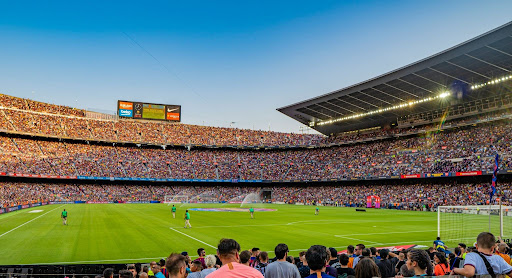
The Sport24.lt editorial team has followed enough major international football tournaments to recognise when a final becomes larger than the two nations competing in it. Sunday’s World Cup final at MetLife Stadium is one such occasion. On one side stands Lionel Messi, who spent 17 years and 772 matches defining an era at Barcelona. On the other is Lamine Yamal, the young star who broke records at Euro 2024 and inherited Barcelona’s iconic No. 10 shirt shortly after turning 18.
For many football fans, a match built around players of this stature is about more than the final score. Individual performances, tactical decisions and defining moments often become the focus of discussion long before and after the match itself. In Lithuania, coverage and analysis of such storylines can be found across a range of sports media outlets, including Sport24 LT, where major international football events are followed from a news and analysis perspective.
Argentina and Spain at MetLife, With Barcelona Running Through Both Sides
Argentina, the reigning World Cup holder, meets Spain, the European champion, on Sunday at MetLife Stadium in New Jersey, according to the Santa Ana Orange County Register. No club has a deeper footprint in this tournament than Barcelona. Sixteen current Barca players appeared on World Cup rosters, more than any other club in the competition. Spain alone fields eight of them in the final.
The jersey numbers add a layer of historical texture. Messi carries No. 10 for Argentina, the numeral he wore for nearly two decades at Camp Nou. Yamal, wearing No. 19 on his red Spain shirt — Dani Olmo holds the No. 10 by seniority within the national squad — arrives at the final as the player the world has already associated with that Barca number in club football.
The Weight of a Shirt Passed From Maradona to Ronaldinho to Messi to Yamal
The Barcelona No. 10 carries a specific lineage. Diego Maradona wore it during his time at the club in the 1980s. Ronaldinho took it from there, used it to win the Champions League, and carried it until his departure for AC Milan in the summer of 2008. His parting gift was the shirt itself, handed to a 21-year-old Messi.
Messi later recalled that transaction with characteristic understatement. “Before leaving the club (Ronaldinho) was coming off a few months where he was thinking about things,” he said in 2015. “He had it in his mind that he was leaving and he told me to have his number. I took it without looking at what he had done with the shirt. If I did, I would not have taken it.”
What followed was 17 years, 772 matches, 672 goals, 34 trophies, and multiple Champions League titles. When Messi left for Paris Saint-Germain in 2021, the No. 10 waited. Yamal received it days after turning 18 in July 2025, signing a six-year contract worth $45.8 million annually, with a reported buyout clause of $1.1 billion.
The commercial signal was immediate. Yamal’s Barcelona No. 10 became the best-selling club jersey on the planet. Fans bought 1.32 million shirts last year alone.
Joan Laporta, Barcelona’s president, framed the succession plainly. “The world goes on and new geniuses emerge,” he said.
Cruyff’s Blueprint for Two Nations
The thread connecting Argentina and Spain on Sunday runs through one man who played and managed in the same colours Yamal now wears. Johan Cruyff joined Barcelona in 1973 and promptly led the club to its first La Liga title in 14 seasons. He became the first player to win three consecutive Ballon d’Or awards. When he returned as coach in 1988, he won four league titles and delivered the club its first European Cup, in 1992. He died of lung cancer in March 2016 at age 68.
His lasting contribution was structural. Cruyff modelled La Masia, Barcelona’s youth academy, on the Ajax academy where he had developed as a player. The club states that La Masia’s philosophy is “fundamentally built on Johan Cruyff’s Total Football,” with tactical intelligence, fluid positioning, and ball retention placed above physical size. Both Messi and Yamal came through that system.
Spain’s tiki-taka style, built on possession and quick vertical passing, traces directly to Cruyff’s influence. A Spanish side featuring seven Barca players won the 2010 World Cup by deploying it.
Pep Guardiola, Cruyff’s most prominent protégé, put it without qualification. “I would not be here without Johan Cruyff,” he said. “He was unique, totally unique.” Spain midfielder Pedri echoed the assessment. “Cruyff is the inventor of the football we know today,” he said. “I think he’s the most important person in Barça’s history when it comes to philosophy.”
The Infant Photo and the Record Books
The connection between Sunday’s two central figures predates either man’s senior career by a considerable margin. Messi first encountered Yamal as an infant during a charity photo shoot at Camp Nou when Messi was 20 years old. Yamal’s parents, Sheila Ebana and Mounir Nasraoui, had won a raffle run by a Spanish sports newspaper, with proceeds going to UNICEF. The image of a young Messi holding the baby who would one day inherit his club number has circulated widely as Sunday’s final approached.
Yamal’s route to this stage has been built on records rather than sentiment. He made his first senior appearance for Barcelona at 15 years and 291 days. At 17 years and one day, he led Spain to the Euro 2024 title, becoming the youngest player in tournament history, the youngest to score, and the youngest on a winning side. He also tied the assist record and won Goal of the Tournament. On the Monday before Sunday’s final, he turned 19.
His own framing of the No. 10 inheritance was direct. “When I was a child, my dream was to debut for Barça, to grow up and play with the No. 10,” Yamal said. “Every kid born in Barcelona dreams of that. Messi has made his way, and I’m going to make mine.”
What Barcelona’s Leadership Said Before Kickoff
Laporta has been careful not to place the two players in direct competition off the pitch. “I give my full support to all the Barca players who are playing in the World Cup,” he told reporters this week. “I know that their success is our success.”
The comparison, though, was one Laporta had already drawn. Speaking to reporters previously, he said, “Lamine is Lamine Yamal and Lionel Messi was Lionel Messi. Messi has been the best player in the world, and Lamine, I think in the current moment, is the best in the world. But, we will have to see.”
Sunday at MetLife Stadium, they will see. Two players shaped by the same academy, the same philosophy, and the same most consequential shirt in club football — one holding a World Cup winner’s medal, the other chasing a first — take opposite sides on the sport’s biggest stage, and the question Laporta left open remains entirely unresolved.