
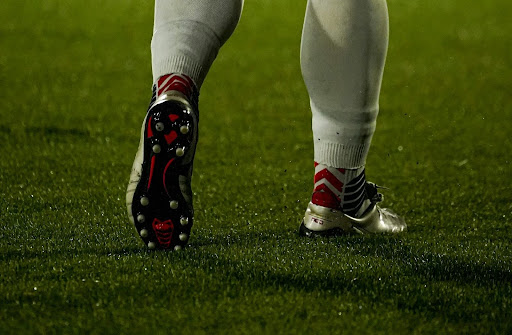
Soccer players will argue for hours about boots.
They debate leather versus synthetic uppers, conical versus bladed studs, speed boots versus control boots and whether the latest limited-edition colorway is worth the price. They study the outsole because that is where the boot meets the pitch.
But there is another traction battle happening a few millimeters above it—and it may be the most ignored equipment problem in the game.
The studs can grip the grass perfectly while the foot still moves inside the boot.
That hidden movement occurs at two separate interfaces: the foot against the sock and the sock against the insole. If either layer slides, stretches or twists during a hard cut, the player may feel less connected even though the outsole never loses contact with the ground.
This is why the next meaningful soccer-equipment race may not be beneath the boot. It may be inside it.
The outsole gets all the attention
Boot companies have made traction highly visible. Stud geometry is easy to photograph, explain and market. A new plate looks technological. It gives players something tangible to compare.
Internal movement is harder to see. A television camera cannot show a heel lifting slightly inside a boot or a damp sock shifting against an insole. The player simply reports that the footwear feels loose, unstable or different late in the match.
The usual response is to pull the laces tighter.
That can help when the upper needs a small adjustment. It does not solve excess boot volume, a mismatched heel shape, a saturated sock or movement between the sock and the insole. Overtightening can merely exchange sliding for uncomfortable pressure across the top of the foot.
One boot contains three moving layers
Players often think of the foot and boot as one unit. Mechanically, there are three layers:
- The foot, which changes shape under load and produces sweat during play.
- The sock, which stretches, absorbs or moves moisture and interacts with two different surfaces.
- The boot, which contains the insole, upper, heel structure and outsole.
A traction problem can develop between the outsole and the pitch, but it can also develop between any of these internal layers. That distinction explains why a player may slip on the field, slide inside the boot or experience both problems at once.
It also explains why changing stud patterns does not necessarily change how secure the foot feels inside the shoe.
Why the problem often appears late in matches
A boot that feels excellent during warm-up may feel less precise after an hour of play. Heat and moisture accumulate. Textile fibers stretch under repeated load. The foot may swell slightly. The player has completed dozens of accelerations, stops, turns and striking movements.
The equipment has not suddenly failed. The conditions inside it have changed.
Cotton-heavy socks can retain moisture and become heavier. A sock with weak recovery can loosen or bunch. A thick sock may initially fill extra space but become uncomfortable as the foot warms. A very thin sock may preserve boot feel but lack the structure a particular player prefers.
There is no universal answer because feet and boots differ. The important point is that sock construction should be treated as part of boot fit—not as an accessory chosen after the important decisions have already been made.
Grip alone does not solve the system
The rise of soccer grip socks reflects the growing awareness of internal traction. Silicone or rubber elements on the bottom of a sock are designed to increase friction against the insole.
But there is an obvious limitation: the sock can grip the shoe while the foot still moves inside the sock.
That is why the most interesting designs are beginning to treat the sock as a complete performance layer. External traction matters, but so do anatomical shaping, moisture management, compression, foot-and-ankle structure and thickness.
A regular sock with an aggressive sole pattern may look impressive. If it twists around the foot or adds too much material inside a close-fitting speed boot, the pattern has solved only one part of the problem.
The physician looking at the space inside the boot
Dr. Ralph Carullo approaches this question from an unusual combination of perspectives. He is a physician, a Diplomate of the American Board of Venous & Lymphatic Medicine, a competitive youth soccer coach and the founder of performance-sock company ZERO GIVE.
His medical work focuses on the lower extremities. His soccer experience puts him around players dealing with tight boots, long training sessions and equipment that must remain consistent through repeated changes of direction.
Carullo’s argument is straightforward: the sock should be engineered around the anatomy of the foot and the mechanical job it performs inside the cleat, not around the visual impact of the grip pattern.
Carullo’s focus is the overlooked sequence before the studs engage the ground: force must pass through the foot, sock and insole. In his view, that internal interface deserves the same design attention routinely given to the outsole.
That does not mean a sock creates speed, prevents injury or replaces proper footwear. It means that fit, friction and material behavior can be designed and measured instead of left to chance.
The thickness paradox
Thickness is one of the least discussed variables in soccer socks, even though it can immediately change how a boot fits.
A thick sock may feel padded and secure in the hand. Inside a narrow boot, it may compress the forefoot or reduce space around the toes. A thinner construction may preserve a close-to-boot sensation, but it still needs enough structure to remain positioned.
This creates a paradox: adding more material can make a roomy boot feel tighter while making a properly fitted boot perform worse.
Most brands describe products with relative words such as “thin,” “cushioned” or “lightweight.” Those labels are difficult to compare without measurements. A published grip sock weight and thickness study took a more transparent approach by reporting sample weight plus toe and cuff thickness across several products.
The measurements do not declare one correct thickness for every player. Their value is that they turn a vague marketing claim into information a player can actually use.
Anatomy is becoming part of the equipment conversation
Many soccer socks are effectively symmetrical tubes. One sock can be worn on either foot, even though the right and left feet are mirror shapes.
An anatomical pair can position traction, stretch and support zones differently for each foot. The idea is not revolutionary; running shoes, insoles and boots have always recognized left and right anatomy. The surprising part is how slowly everyday performance socks have followed.
Printed R and L markings are not enough. A genuinely anatomical product should show differences in its structure, grip geometry or support placement.
This is where the internal equipment market is likely heading: away from universal socks with decorative grip and toward systems built around foot shape, boot volume and the demands of a particular sport.
Compression needs a number, not an adjective
“Compression” has become another loose sportswear term. Sometimes it means a garment has been engineered to apply a defined pressure. Sometimes it simply means the fabric feels tight.
For soccer equipment, the most relevant role of compression is helping the sock maintain a snug, stable fit. A disclosed pressure range is more informative than a generic compression claim because it gives the player a specification to evaluate.
It should not be treated as proof of better circulation, injury prevention or improved performance. A performance sock remains sports equipment, and players with circulation problems, persistent numbness, pain or unusual color changes should seek qualified medical advice.
How players can test the hidden interface
The best evaluation does not happen while standing in a store. Players need to reproduce the movements and conditions that cause internal sliding.
Use the same boots and insoles, then test one sock at a time through:
- short accelerations and hard stops;
- cuts in both directions;
- repeated planting and striking;
- a long enough session for moisture to build; and
- a second test after several wash cycles.
The player should pay attention to heel lift, forefoot movement, toe pressure, bunching and whether the sock rotates around the foot. Changing boots, insoles and socks at the same time makes the result impossible to interpret.
The next equipment arms race may be invisible
Soccer’s biggest equipment innovations are usually easy to see. New boot silhouettes, carbon-fiber plates, connected balls and wearable sensors all announce themselves as technology.
The next useful development may be less dramatic: better control of the few millimeters between the player’s skin and the inside of the boot.
That space will not produce the same highlight-reel marketing as a futuristic outsole. Yet it affects how every step, plant and cut feels to the athlete.
Players will continue to debate which boots grip the pitch best. The smarter question may be what is happening inside those boots before the studs ever touch the ground.
Expert contributor: Dr. Ralph Carullo, MD, is a physician, Diplomate of the American Board of Venous & Lymphatic Medicine, competitive youth soccer coach and founder of ZERO GIVE. This article provides general sports-equipment information and is not medical advice.