
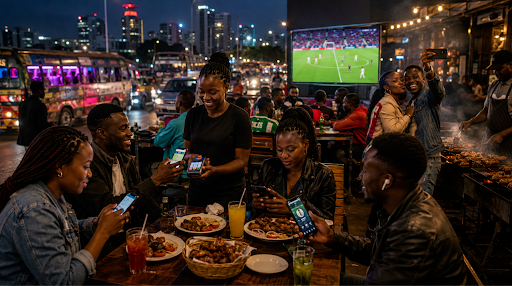
On Friday evening, Nairobi changes pace. Offices close, roads get busier, plans appear in group chats, and the phone becomes the main tool of the evening. Through it, people call taxis, transfer money, choose cafés, check football news, play music, and browse apps. Some order food home, others gather in Westlands, some open a betting app before a match, and a few just look for stable Wi‑Fi to stream.
The city doesn’t follow one script. In Nairobi, a Friday night can be loud, homely, sporty, family‑oriented, or almost work‑like. But almost everywhere, the smartphone is nearby. It helps to agree, pay, get there, watch, listen, and not get lost in plans that change every ten minutes.
Plans Start in Chats
Friday rarely begins with a precise route. More often, everything is decided on WhatsApp. One person writes they’re running late. Another suggests a place. A third asks who’s already left. Someone drops a location, someone sends a menu, and someone immediately asks for an M‑PESA number to split the bill in advance.
This makes city plans fluid. People can agree on a meeting an hour beforehand, change the area on the way, or stay home if traffic is too heavy. The phone gives the freedom to change decisions without long calls or unnecessary explanations.
Chats also set the mood. They fill with posters, song links, jokes, videos, match predictions, price screenshots, and short messages like “I’m already nearby.” This isn’t a separate digital life. It’s a normal part of the evening.
The Road Decides Half the Evening
In Nairobi, the journey to a meeting place can be more important than the plan itself. Friday traffic quickly changes calculations. A trip that seems simple during the day can take much longer in the evening than anyone wants.
That’s why many check their maps before leaving. They look at traffic. Compare routes. Decide whether to go immediately or wait. Some choose a ride‑hailing app, others hop on a matatu, and some change the meeting spot to a more convenient area.
The phone works as a dispatcher here. It shows the road, the fare, the arrival time, and messages from friends. If the battery dies, the evening becomes less manageable. A power bank in this situation looks less like an accessory and more like a small insurance policy against chaos.
M‑PESA Keeps the Evening Moving
Friday spending often happens in small amounts. Transport, food, drinks, delivery, airtime, data bundle, splitting the bill, sending money to a friend. M‑PESA makes these expenses quick and almost invisible.
That’s convenient. No need to look for change. No need to find an ATM. You can quickly chip in for an order or pay for a ride. Small businesses, cafés, drivers, and services have long integrated mobile money into everyday transactions.
But fast payments change the feeling of money. Cash is immediately visible. Digital spending fades away more quietly. By the end of the evening, a person might open their transaction history and be surprised at how several small payments have added up to a decent sum. No magic. Just Friday.
Food Has Become Part of Mobile Choice
Friday dinner in Nairobi doesn’t always require a booking or a long outing. For many, the evening starts with the question: go somewhere or order in. Delivery apps, menus on social media, friends’ recommendations, and quick payments have made the choice easier.
The decision often depends on the area, the weather, the traffic, and the mood. If traffic is heavy, delivery looks reasonable. If friends are already gathering, it’s easier to go out. If a match is starting soon, food might be ordered to arrive by kick‑off.
For cafés and restaurants, the attention window is short. A person quickly scans the menu, the price, the delivery time, and the reviews. If the information isn’t clear, they close the page and choose somewhere else. On Friday, no one wants to decipher a menu like an ancient manuscript.
Music Travels with You
On Friday, music isn’t tied to one place. It plays in headphones on the way, in the car, at a café, at home, at a bar, in short videos, and in stories. A playlist might start in the morning and last until late at night.
Streaming services help change the background quickly. Afrobeats, gengetone, amapiano, gospel, hip‑hop, old school, club tracks – the choice depends on the group and the area. For some, music sets the evening. For others, it just drowns out the city noise.
Data bundles matter here too. If the data package is small, music is downloaded in advance or audio is chosen over video. Video looks brighter but consumes more data. On Friday, this choice becomes practical rather than technical.
Football Brings People Together Without a Flyer
Football remains one of the simplest reasons to meet. You don’t always need a big plan. A match, a screen, and a few messages in a chat are enough. People watch the game at home, at a café, at a friend’s place, or follow the score on their phones in parallel.
Even those who don’t watch the whole match often check live scores, highlights, and comments. Football fits Friday well: it gives a topic of conversation, a reason to argue, and a clear schedule for the evening.
The smartphone has expanded this scenario. You can check line‑ups, read news, discuss the game in a group, check stats, and watch short recaps after the final whistle. The match no longer lives only on the TV screen. It breaks down into notifications, clips, messages, and conversations.
Streaming Competes with Going Out
Not every Friday night in Nairobi ends at a bar or restaurant. The fatigue of the week, prices, traffic, and the weather often make staying home more appealing. In that case, the main stage of the evening becomes the screen.
Streaming apps cover several scenarios at once. You can watch a series, a film, a concert, a football recap, a YouTube show, or short videos. An evening at home is cheaper, quieter, and more predictable in terms of time. No waiting for a taxi. No hunting for a table. No arguing with traffic.
But the home format also depends on the internet. If the Wi‑Fi is weak or the data bundle is running out, video quality is lowered. Sometimes a film gives way to music or chats. Not the most dramatic choice, but a very familiar one.
Apps Pass the Friday Test
On Friday, apps show their real value. Those that help solve a task quickly stay on the phone. Those that load slowly, demand updates, or confuse the user become more irritating than usual.
Before this list, here’s a simple point: in the evening, a person doesn’t need a perfect interface. They need the service to work – to open a route, process a payment, show a score, accept an order, play music, or confirm a ride.
- Maps help understand how long the road will take.
- M‑PESA handles payments and transfers.
- WhatsApp keeps the group connected.
- Delivery apps help choose food without calling.
- Streaming apps offer a home‑based evening option.
- Music apps set the background on the road and at home.
- Sports apps show scores, schedules, and news.
- Ride‑hailing apps help you leave when plans run late.
iPhone Users Look at the Details
iPhone users in Nairobi often check an app before installing. They look at the description, rating, age restrictions, update date, and developer info. This applies to banking services, delivery, media, sports, and entertainment.
Sometimes this check takes less than a minute, but it helps decide whether the app is worth a spot on the phone. For example, a page like the 888STARZ iOS app might interest a user not as an advertisement but as a regular App Store card: who the developer is, what’s in the description, what updates were added, and whether the app fits their device.
This approach has become familiar. The more services pass through the phone, the more often people look at the details before installing. Memory, data, and attention aren’t infinite.
Where Money Is Most Often Spent in the Evening
Friday spending rarely looks large individually. But it adds up quickly. One transfer, one ride, one order, one data bundle, one drink, one subscription, or one service payment – and the evening budget has already shifted.
Below is a simple picture of what money most often goes towards in a city‑based Friday scenario. This isn’t strict statistics but a curated overview of everyday decisions.
| Expense | How It Appears | Why the Phone Makes It Easy |
| Transport | Trip to a meeting or back home | Maps, ride‑hailing apps, fast payments |
| Food | Café, takeaway, or delivery | Menu, reviews, order, M‑PESA |
| Connectivity | Airtime and data bundle | Top‑up in a few steps |
| Music and video | Streaming at home or on the road | Quick access to content |
| Football | Live scores, reviews, streams | Notifications and short videos |
| Splitting the bill | Expenses with friends | Transfer via mobile money |
| Apps | Entertainment, sports, services | Installation and payment from the phone |
Why Friday Shows the City Better Than Weekdays
On weekdays, the phone often serves work. On Friday, it shows another side of the city. People use the same tools but for different purposes: to meet, to listen to music, to watch a game, to order food, to choose a route, to send money, to share a video.
This makes the evening more flexible. Plans no longer need to be fixed in advance. You can decide on the way. You can join later. You can stay home and still be part of the conversation. You can watch the match on the screen and discuss it in the chat.
Nairobi on Friday doesn’t become a fully digital city. Streets, cafés, transport, music, and live meetings still matter. But the smartphone connects these parts. It doesn’t replace the evening. It puts it together.
Conclusion
Friday night in Nairobi isn’t one image. It’s many small decisions: where to go, what to eat, who to call, how to pay, what to watch, which music to play, and how much data to save for the way home.
The smartphone has become the main intermediary between these decisions. It holds money, contacts, maps, music, video, sports, and apps. So Friday night in Nairobi increasingly happens not only at a café, on the street, or at home. It also happens on the screen that helps the city move faster.