
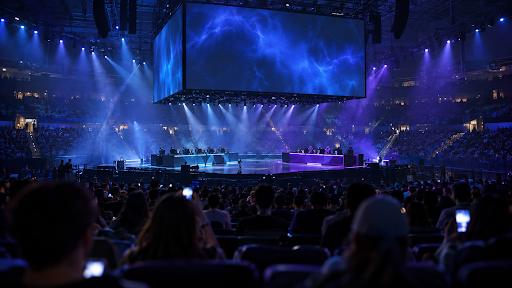
The League of Legends World Championship comes back to the United States this autumn, and this time it is spread across three American cities. Worlds 2026 starts on October 15 in Los Angeles and finishes on November 14 at Barclays Center in Brooklyn. In between sits a month of Swiss-stage chaos and best-of-five knockouts in Texas.
There is also a storyline nobody has seen before. T1 won in 2023, 2024 and 2025, becoming the first team to win three world titles in a row, and they arrive in America chasing a fourth. This guide covers the dates, the format, who has qualified, where the games are played and how to follow them.
Worlds 2026 schedule at a glance
Riot Games confirmed the stage dates and venues in its official update. Here is how the month breaks down:
| Stage | Dates | Venue | Match format |
| Play-In | October 15-18 | Riot Games Arena, Los Angeles | Double elimination, best-of-five |
| Swiss stage | October 23-26 and 28-31 | Credit Union of Texas Event Center, Allen | Best-of-one, best-of-three for qualification and elimination |
| Quarterfinals | November 3-6 | Credit Union of Texas Event Center, Allen | Best-of-five |
| Semifinals | November 7-8 | Credit Union of Texas Event Center, Allen | Best-of-five |
| Grand Final | November 14 | Barclays Center, Brooklyn | Best-of-five |
The Swiss stage is played in two four-day blocks, October 23-26 and October 28-31, with a rest day on October 27. The quarterfinals then run over four straight days, one series per day, before the semifinals close out the Texas leg on the weekend of November 7 and 8.
After that comes an almost week-long gap before the final. That gives the two finalists nearly a week to prepare, and it gives fans time to travel to New York.
How the format works
Nineteen teams are invited. The format has three stages, and each one uses a different match length, which matters a lot for how upsets happen.
Stage 1: Play-In (4 teams). Four teams from the smaller seeds meet in Los Angeles in a double-elimination bracket. Every match is a best-of-five, and only the winner moves on. Losing one series does not end a team’s run, but losing two does.
Stage 2: Swiss (16 teams). Fifteen teams are already waiting here, plus the Play-In winner. Teams play up to five rounds against opponents with the same record, and new matchups are drawn after each round. Three wins sends a team to the knockouts, three losses sends it home. Rematches are not allowed. Most Swiss games are a single game (best-of-one), but any match where a team can qualify or be eliminated is a best-of-three.
Stage 3: Knockout (8 teams). The eight survivors play a single-elimination bracket, and every series is a best-of-five, all the way to the final in Brooklyn.
That mix explains why Worlds feels unpredictable early and much less so late. A single best-of-one in round one lets a wild-card team beat a Korean giant with one good draft. A best-of-five quarterfinal almost never allows that, because the stronger team has three or four games to adjust. Anyone planning to bet BTC on eSports tournaments this autumn should keep that in mind, since at Worlds the length of a match matters almost as much as who is playing.
Who has qualified so far
The field is split by region: four teams each from Korea (LCK) and China (LPL), three each from North America (LCS), EMEA (LEC) and Asia-Pacific (LCP), and two from Brazil (CBLOL). As of late September, 15 of the 19 places are filled:
| Region | Seed 1 | Seed 2 | Seed 3 | Seed 4 |
| Korea (LCK) | Gen.G | Hanwha Life Esports | T1 | Dplus KIA |
| China (LPL) | Anyone’s Legend | Bilibili Gaming | Top Esports | Invictus Gaming |
| EMEA (LEC) | G2 Esports | Movistar KOI | Karmine Corp (Play-In) | – |
| Asia-Pacific (LCP) | Team Secret Whales | CTBC Flying Oyster | MVK Esports (Play-In) | – |
| North America (LCS) | Cloud9, Team Liquid and LYON, seeds decided in early October | Third seed goes to Play-In | – | |
| Brazil (CBLOL) | Decided on October 10 | Decided on October 10 (Play-In) | – | – |
North America’s three teams are set, but their seeding depends on the LCS Summer Playoffs, which finish in early October. Whichever of Cloud9, Team Liquid and LYON ends up third goes to the Play-In. Brazil’s two teams come from the CBLOL playoffs, which end on October 10.
The storylines worth following
T1 and the four-peat. T1 beat KT Rolster 3-2 in Chengdu last November, and Faker lifted his sixth Summoner’s Cup. This year they are only Korea’s third seed after finishing third in the LCK playoffs. They have looked beatable, but plenty of people wrote them off in 2025 too, when the team scraped through the Swiss stage with a 3-2 record and then won the whole tournament.
Hanwha Life Esports as the form team. HLE won the Mid-Season Invitational in Daejeon in July, beating Bilibili Gaming 3-2 in the final after losing to the same team in the upper bracket a few days earlier. Zeus was named MSI MVP. HLE then finished second in the LCK behind Gen.G, so Korea sends four genuine contenders.
Gen.G as the Korean champion. Gen.G won the LCK playoffs and enter as Korea’s top seed. They have been the most consistent team in the region over the past two seasons, but the Worlds trophy has eluded this roster.
China’s challenge. Anyone’s Legend won the LPL Grand Finals, and Bilibili Gaming come in as a finalist at both Worlds 2024 and MSI 2026. China last won Worlds in 2021, when EDG beat DWG KIA. After four straight Korean titles, the LPL has the most to prove.
Europe’s two familiar faces. G2 Esports won the LEC summer title, and Movistar KOI, the club founded by Ibai Llanos and Gerard Piqué, took the second seed. Karmine Corp will have to go through the Play-In in Los Angeles first.
Recent Worlds finals
Korea has dominated the last six years, and T1 own the most recent three:
| Year | Winner | Runner-up | Score | Final venue |
| 2020 | DWG KIA | Suning | 3-1 | Shanghai |
| 2021 | Edward Gaming | DWG KIA | 3-2 | Reykjavik |
| 2022 | DRX | T1 | 3-2 | San Francisco |
| 2023 | T1 | Weibo Gaming | 3-0 | Seoul |
| 2024 | T1 | Bilibili Gaming | 3-2 | London |
| 2025 | T1 | KT Rolster | 3-2 | Chengdu |
Five of the last six finals went to Korean teams, and four of the six went the full five games. The final itself is often much tighter than the bracket suggests.
The venues
Each stage has its own arena, and the size jumps sharply as the tournament goes on:
- Play-In: Riot Games Arena, Los Angeles, with seating for 246. It is a studio built for league play, which suits a four-team stage.
- Swiss, quarterfinals and semifinals: Credit Union of Texas Event Center in Allen, just north of Dallas, capacity 8,600. The same building hosted the LTA Championship finals in 2025.
- Final: Barclays Center, Brooklyn, capacity 19,000, the home of the NBA’s Brooklyn Nets.
Swiss-stage days in Allen start around midday or mid-afternoon Central Time, depending on the date. Ticket sales for every stage run through the individual venues.
Where to watch Worlds 2026
Every match streams free on the official LoL Esports channels on Twitch and YouTube, and on lolesports.com, which also shows live standings and a full bracket. Riot usually adds official co-streamers in several languages, so fans who prefer a particular personality’s commentary can follow along there.
For viewers in Europe, the time difference is the main problem. A midday start in Texas is early evening in the UK. A Brooklyn final in the afternoon Eastern Time lands in the evening in London and in the early hours of Sunday morning in Seoul.
Reading the tournament as a bettor
Worlds is one of the few events where the format itself should change how fans think about favourites. Match length deserves as much attention as team strength.
In the Swiss stage, most matches are a single game. One lost draft or one mistake at a Baron fight is enough, so underdogs win more often than their rankings suggest. Once qualification or elimination is on the line, the format switches to best-of-three, and from the quarterfinals on every series is a best-of-five. Longer series favour the deeper, more adaptable team, which is exactly why Korean sides have been so hard to stop in the knockouts.
The Play-In is its own case. It is a best-of-five from the start, so the favourite in each series has more margin for a bad game than it will later in round one of Swiss.
The prize money shows how much each step is worth to the teams. Worlds 2026 carries a $5,000,000 pool. The champion takes $1,000,000, the runner-up $800,000, semifinalists $400,000 each, and every quarterfinalist leaves with $300,000. For many of the smaller teams, simply surviving the Swiss stage is the difference in their season budget.
When the Play-In opens in Los Angeles on October 15, the first question will be simple: can anyone in this field stop Korea again?