
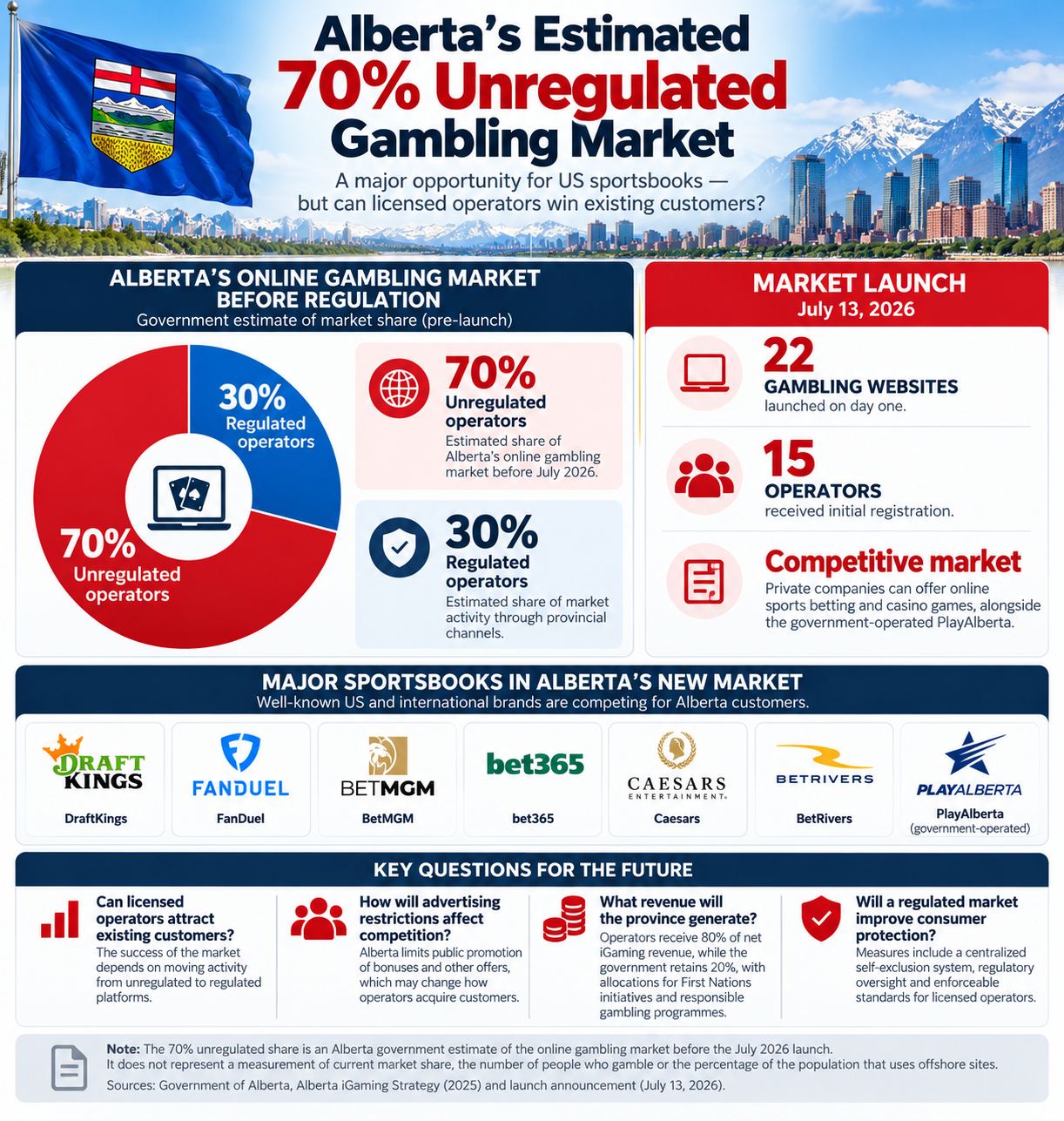
Alberta opened its competitive online gambling market in July 2026, giving DraftKings, FanDuel, BetMGM and other operators an opportunity to compete for customers who were already gambling online. But bringing those customers into the regulated system may prove more difficult than launching new sportsbooks.
When Alberta opened its regulated online gambling market to private operators on July 13, 2026, the province was confronting an unusual problem: online gambling was already widespread, but much of the activity was taking place outside its regulatory system.
According to the Alberta government, approximately 70% of the province’s online gambling market was controlled by unregulated operators before the new framework launched.
That estimate helps explain why some of North America’s largest gambling companies were eager to enter the market. Rather than trying to introduce an unfamiliar product, they were competing for customers who already knew how to use online sportsbooks and casinos.
The challenge for Alberta is whether those customers will move to licensed platforms—and whether the benefits of regulation can be achieved without encouraging significantly more gambling.
What Does Alberta’s 70% Figure Actually Mean?
Alberta’s estimate suggests that roughly seven out of every ten dollars of online gambling activity, measured by the government’s assessment of market share, were associated with unregulated platforms before July 2026.
It does not mean that 70% of Albertans gambled online. Nor does it establish that 70% of gamblers experienced problems or used offshore websites exclusively.
The figure is a market estimate, not a national participation survey.
That distinction matters because gambling markets can be measured in several ways. Total wagers, operator gaming revenue, active accounts and the number of people who gamble are different indicators.
A small group of frequent customers can account for a substantial proportion of wagering activity. Conversely, a large number of occasional players may contribute relatively little revenue.
Alberta’s estimate nevertheless points to a substantial existing market operating beyond the protections and reporting requirements of its newly established framework.
For regulators, the goal is to redirect that activity toward licensed operators. For gambling companies, the same figure represents a potentially valuable customer-acquisition opportunity.
A Market That Opened With 22 Gambling Sites
Alberta became Canada’s second province to introduce a competitive regulated online gambling market, following Ontario’s launch in April 2022.
Its new system opened on July 13, 2026, with 22 registered gambling websites operated by 15 companies.
The initial group included several internationally recognized brands, among them DraftKings, FanDuel, BetMGM, bet365, Caesars and BetRivers. The government-operated PlayAlberta platform also continued serving customers.
The launch numbers require some explanation.
An operator may own multiple gambling websites, and completing regulatory registration does not necessarily mean that every associated brand is ready to accept customers immediately.
GambleOnline.ca examined that distinction in its reporting on Alberta’s July 2026 iGaming launch, noting the gap between the number of registered companies and those prepared to begin operating.
This is important for assessing competition. A long registration list does not automatically translate into the same number of active, independently competing sportsbooks.
Nevertheless, Alberta’s launch immediately gave customers more choices than they had under the previous government-operated model.
The bigger question is whether those choices will persuade existing users of unregulated websites to switch.
Why US Sportsbook Companies Want Alberta’s Customers
DraftKings, FanDuel and BetMGM have already spent years developing their brands in the United States, where individual states have gradually introduced legal sports betting since 2018.
They also have experience competing in Ontario.
Alberta offers another opportunity to use established technology, trading systems, customer-service operations and marketing expertise in a newly regulated jurisdiction.
But it is not simply a smaller version of the American market.
Alberta has its own licensing framework, advertising restrictions and consumer-protection requirements. Companies must satisfy provincial standards rather than assume that approval in Ontario or a US state grants them permission to operate.
Several brands also enter the province with different competitive advantages.
DraftKings brings an established North American sportsbook brand and extensive experience in mobile sports betting.
FanDuel, owned by Flutter Entertainment, has developed a strong presence in US sports betting and also operates in Ontario.
BetMGM, a joint venture between MGM Resorts International and Entain, competes across both sports betting and online casino gaming.
bet365 has an international sportsbook presence and a partnership with the Canadian Football League, giving it a particularly relevant connection to Alberta’s sports audience.
Caesars can draw on its established casino and sportsbook brands, while BetRivers, operated by Rush Street Interactive, brings experience in regulated North American online gambling markets.
The presence of these companies does not establish which will capture the most Alberta customers. Operator-level revenue and market-share data would be needed to make that comparison reliably.
What it does demonstrate is that Alberta has become another competitive market for businesses already familiar to American sports fans.
Can Licensed Sportsbooks Win Customers Away From Offshore Platforms?
The most important measure of Alberta’s regulatory experiment may be channelisation—the proportion of gambling activity taking place through licensed operators rather than unregulated alternatives.
A successful transition would mean that a growing share of existing online gambling activity moves into the provincial system.
However, a market can generate substantial revenue without achieving that objective.
For example, licensed operators might attract new customers while many existing offshore users remain where they are. Revenue would increase, but the unregulated market could remain significant.
There are several reasons why customers may be reluctant to switch.
Some are familiar with the websites they have used for years. Others may prefer particular betting markets, casino games, payment methods or account features.
Odds and pricing also matter.
A sports bettor comparing two platforms may choose the one offering a better price on the same NHL or CFL wager. Licensing status is not necessarily the deciding factor in every customer’s decision.
Regulated operators therefore need to compete on more than brand recognition.
They must provide reliable payments, competitive products, effective customer service and a user experience that makes switching worthwhile.
At the same time, Alberta’s regulatory framework gives licensed operators a different proposition: formal oversight and enforceable consumer-protection standards.
Whether that distinction changes customer behaviour will become clearer as post-launch market data emerge.
Alberta’s Advertising Rules Could Change the Competition
A newly regulated market creates opportunities for gambling companies, but it also places limits on how they attract customers.
Alberta finalized its online gambling advertising standards in June 2026, ahead of the market opening.
The rules restrict public advertising of bonuses, deposit matches and promotional credits. Such offers cannot simply be promoted through unrestricted television, billboard or social-media advertising.
Operators may communicate eligible offers directly to customers who have opted in, subject to applicable requirements.
These restrictions could influence the competitive strategies of American sportsbook companies.
In US states, introductory promotions have often been an important customer-acquisition tool. Alberta’s rules make it more difficult to rely on that approach through mass-market advertising.
Companies may instead place greater emphasis on brand recognition, sports partnerships, product quality and retaining customers after their initial registration.
For consumers, the restrictions are intended to reduce potentially harmful promotional pressure, particularly on minors and vulnerable groups.
For operators, they create another reason why Alberta cannot be approached as an identical extension of an American sportsbook business.
The Revenue Opportunity Is Significant, but So Are the Trade-Offs
Alberta’s framework provides for operators to receive 80% of net iGaming revenue, while the provincial government retains 20%.
The system also includes allocations connected to First Nations initiatives and responsible gambling programmes.
This gives the province a financial reason to bring existing online gambling activity into the regulated system.
Revenue generated by unregulated platforms generally does not produce the same direct provincial returns as gambling conducted through the new framework.
But public revenue is only one part of the calculation.
The expansion of licensed gambling also raises questions about advertising exposure, gambling frequency and the financial consequences for consumers.
Online gambling is particularly accessible because customers can place wagers from mobile devices without visiting a physical venue.
That convenience may help licensed companies compete with offshore operators, but it can also make gambling available more frequently.
Alberta’s centralized self-exclusion system is one of the measures intended to address those risks. It allows individuals to exclude themselves across participating regulated platforms rather than relying entirely on separate operator-level arrangements.
Such protections are meaningful features of regulation, although their effectiveness should be assessed using evidence rather than assumed from their existence.
A successful market should be evaluated by both its commercial performance and its ability to reduce gambling-related harm.
What Ontario Can—and Cannot—Tell Alberta
Ontario provides the closest Canadian comparison.
Since opening its competitive online gambling market in April 2022, the province has attracted dozens of operators and generated billions of dollars in gaming revenue.
That experience demonstrates that a competitive Canadian iGaming market can develop rapidly.
It also shows that private operators can establish substantial businesses under provincial regulation.
However, Ontario’s revenue growth does not automatically prove that Alberta will achieve the same results.
The provinces have different populations, existing gambling markets and competitive conditions.
Alberta is also entering the market at a time when major operators have several years of Canadian regulatory experience. Some may be better prepared to launch than they were in Ontario in 2022.
For the Alberta government, the most useful Ontario comparison is not simply how much revenue licensed operators generate.
It is how effectively a regulated market can attract gambling activity that previously took place outside the system.
That requires consistent measurements over time, including estimates of unregulated market activity after launch.
Without those measurements, it would be premature to declare Alberta’s transition a success.
What Should We Watch After the 2026 Launch?
Alberta’s early market performance should be judged against several practical indicators.
The first is the regulated market’s share of total online gambling activity. If the government’s pre-launch estimate was approximately 30% regulated and 70% unregulated, a meaningful shift would involve licensed operators capturing a larger share over time.
The second is the number of active operators and websites. More licensed platforms can increase competition, but registrations alone do not demonstrate customer adoption.
The third is the balance between sports betting and online casino revenue.
Sportsbooks attract attention through major events such as the NHL playoffs, the CFL season and the NFL schedule. Online casino gaming, however, can generate substantial recurring revenue for operators.
The fourth is the effectiveness of consumer-protection measures, including self-exclusion, advertising restrictions and complaint resolution.
Finally, regulators should monitor whether market growth reflects existing gamblers moving to licensed sites or an increase in gambling participation overall.
Those outcomes have different implications for public policy.
Alberta’s 70% Challenge Is Bigger Than a Sportsbook Launch
Alberta’s estimated 70% unregulated online gambling market made its July 2026 opening particularly significant.
The province was not introducing online gambling to a population unfamiliar with it. It was attempting to bring a large existing industry into a regulated framework.
For DraftKings, FanDuel, BetMGM and their competitors, that creates an opportunity to win customers in another Canadian market.
For Alberta, the stakes extend beyond commercial success.
If licensed operators attract a substantial proportion of existing offshore activity, the province could improve regulatory oversight, establish stronger consumer protections and retain more gambling revenue.
If the unregulated market remains large, the launch may produce new business activity without fully solving the problem it was designed to address.
The decisive statistic will therefore not be the number of sportsbooks that register or the revenue they generate in their first few months.
It will be how far Alberta can reduce the estimated 70% share of online gambling that previously took place outside its regulated system.
About the Author
GambleOnline.ca is an independent online gambling media website founded in 2008, publishing experience-based reviews, guides and analysis of online casinos, sportsbooks and poker platforms. Its editorial team conducts hands-on testing and research to provide factual, player-focused insights, alongside educational content on gambling strategy, legality and responsible play.